Showing posts with label litrerature. Show all posts
Showing posts with label litrerature. Show all posts
Tuesday, 27 November 2012
Where have all the book illustrators gone? The Independent.
Where have all the book illustrators gone? An article from the newspaper The Independent.
This article discusses the reasons for the lack of illustrated adult novels in the last half a century It includes controversial opinions like a lack of decent illustrators and introduces the rise of the inner monologue.
'Up until the Fifties and Sixties it wouldn't be unusual for a mainstream publisher to illustrate adult books. '
'Dan Franklin at Jonathan Cape is one of the few British publishers who bucks the trend. "I think a) it's fashion", he says trenchantly. "And b) there aren't that many great illustrators. It's rare you can come across someone who can draw. Even when you're looking for someone to do book jackets, it's hard to find someone who can draw the human figure – it seems to be unfashionable now."
I fully agree with the fashionability of illustration in books being key to its disappearance but the opinion that 'there aren't that many great illustrators' is, I think, another example of fashion. Why do illustrators have to draw the characters to represent what is occurring in the text?
Simon Prosser, publishing director at Hamish Hamilton: It might be", he says, "that illustration is simply unfashionable. I have a strong, deep attachment to books that were illustrated... I remember from my early reading, the classics of natural history, like Izaak Walton and The Natural History of Selborne and they were all illustrated." Which brings us to another issue, the dearth of publishers with some sort of visual grounding.
Does it matter if adult books are all text? Even the greatest enthusiasts wouldn't say you should illustrate everything. You wouldn't wish on any artist the job of drawing much of Virginia Woolf. But the possibility that illustrations could actually illumine writing and draw out elements of a narrative doesn't seem to count for much any more. And as Posy Simmonds, well-known as a graphic novelist as well as illustrator, observes, illustration can do many things for a novel: "There's lots of choice, whether to interpret, decorate, contradict. It can add to or detract from the writing."
On the change in modern literature:
But there is a problem with the nature of modern fiction. As the novelist Piers Paul Read says, "illustrations are best suited to a novel with a strong narrative, that is to say, illustrating an incident – and there are fewer such novels around.
He (Quentin Blake) thinks that the nature of modern fiction is a challenge, but not an insuperable one. "Once novelists got into the interior monologue... that's what spoiled it for illustration", he says. "But there are things you could do that we've lost the habit of doing. There's a wrong assumption that you're going to draw exactly what the text says. But it calls for a bit of thinking. You don't always want to see what the protagonist looks like. Are you drawing surroundings, atmosphere, furniture? There are ways of contributing to novels. Commissioning drawing, I think, is a habit as much as anything. One doesn't want to say everything should be illustrated. But there are moments when something very interesting could be done. We've lost the habit of thinking like that."
The perception of illustration in books as something for children:
Because illustration is now the preserve of children's books, there's a sense that this is where it belongs, with childish things like comics. Or as Quentin Blake says, "there's a feeling it's not quite grown up to have pictures." Posy Simmonds agrees: "there's a sense that pictures are something you grow out of."
On The Resurgance of the illustrated book in the digital platform:
But it's not too soon to write off the possibility of illustration making a return. And curiously enough, it comes from the very development that people darkly assume to be undermining publishing as we know it: digital technology. Kindle makes the reproduction of colour plates far cheaper than now. As Simon Rossiter observes: "Books are more and more in the digital world – there's a real case for making books more special... it would be great to have a special Kindle edition of a novel." Dan Franklin is even more upbeat: "We'll find in the years to come that there's a renewal of illustration in books. Because of Kindle there's a new impulse to make the physical hardback book a more beautiful object. Illustration will be part of that. And when the enhanced e-book is up and running, it will be part of that too."

Wednesday, 21 November 2012
A working partnership with DeLoss McGraw
The poet W.D. Snodgrass talks of his working relationship with painter DeLoss McGraw.
He touches on how both artist and writer occasionally misunderstood each other and their individual ideas and interned responses which in itself is interesting but also explains that the artists work is based on a lifetime of experiences and knowledge that he draws upon draw upon unconsciously, much as we as culturally/historically aware readers do when we 'read' an image.

He touches on how both artist and writer occasionally misunderstood each other and their individual ideas and interned responses which in itself is interesting but also explains that the artists work is based on a lifetime of experiences and knowledge that he draws upon draw upon unconsciously, much as we as culturally/historically aware readers do when we 'read' an image.

DeLoss McGraw
Tuesday, 20 November 2012
Thompson & Steadman
I'd like to look at the process an artist undertakes when they set out to illustrate a piece of writing, at how decisions are made and how not only the audience but the author responds to them. Thus I want to look at illustrator/writer relationships
Hunter S Thompson & Ralph Steadman


A famous and iconic collaboration the pair heavily influence (some say invented) Gonzo Journalism, a style that attempts to be non-objective and is usually written in first person and published without editing so it reads as the author wrote it. Both Illustrator and author are now inseparable from the style.
Steadman on illustrating the article: "The concept was by Hunter, but the pictures, drawn by me, argumented the crazy dimension he had hoped he could single-handedly create in his fat notebook."
Writing in the New York Times a few months after Thompson's suicide in 2005, Rich Cohen cited Steadman's art as successfully depicting the murk which Thompson had dug up just beneath the surface of manufactured America "The drawings are the plastic torn away and the people seen are monsters." Without Steadman's pictures - Thompson's monsters made flesh- Fear and Loathing would be a wildly different beast."
Obviously the images here majorly changed the way the text was read, the reading experience would be wholly different were it not for the combination, as stated: this is what makes the text successful. The drawings do not illustrate as if to describe but as a second layer, a realisation of what Thompson was trying to say, of the view he had on the world and society. On a baser level the illustrations also reflect the drug fused haze the narrative is written in.
“The pictures weren’t about the story; they were a reflection of the story, what was in Hunter’s mind,” -Steadman
Hunter S Thompson & Ralph Steadman


Creative review issue:
Mark Sinclair
Steadman on illustrating the article: "The concept was by Hunter, but the pictures, drawn by me, argumented the crazy dimension he had hoped he could single-handedly create in his fat notebook."
Writing in the New York Times a few months after Thompson's suicide in 2005, Rich Cohen cited Steadman's art as successfully depicting the murk which Thompson had dug up just beneath the surface of manufactured America "The drawings are the plastic torn away and the people seen are monsters." Without Steadman's pictures - Thompson's monsters made flesh- Fear and Loathing would be a wildly different beast."
Obviously the images here majorly changed the way the text was read, the reading experience would be wholly different were it not for the combination, as stated: this is what makes the text successful. The drawings do not illustrate as if to describe but as a second layer, a realisation of what Thompson was trying to say, of the view he had on the world and society. On a baser level the illustrations also reflect the drug fused haze the narrative is written in.
“The pictures weren’t about the story; they were a reflection of the story, what was in Hunter’s mind,” -Steadman
Make Real Through Fictional Presentation
Looking at an example of an illustration which accompanied a Victorian newspaper article about homelessness it is interesting to note that at the time photography was a used and functional medium and yet an illustrated presentation was preferred to sit alongside the text.
"Yet this should not surprise us in an age when many find the dramatisation of recent events in fictionalised on television or film accounts -of the holocaust say, or of the hostage crisis in the Middle East- more acceptably 'real' than factual and scholarly accounts." - Stuart Sillers, Visualisation in popular fiction.


The most striking point in this quote in which Dickens discusses the actuality of life in the London slums from the preface of Oliver Twist is that "Dickens assumes without question that the 'reality' of urban vice and squalor is that which is presented by Hogarth - a statement of 'truth' of the image which reveals much about the impact of the earlier artist's work upon the writer and also of the larger power of the transmitted vision of the truth rather than the external truth itself at a time when engravings were the major source of reproduced visual data."
People are more willing to take presented visuals as truth when accompanied by the text than they are the reality which they may not be aware of or just unwilling to accept.
The difference is that there is an involvement occurring between the reader and a text or image, they are being presented something which they can then use to recognise the world with and because they have read the text/image have (secondary) experience with and so take that as truth. Its almost like having a preconceived opinion about someone before meeting and getting to know them.
"Yet this should not surprise us in an age when many find the dramatisation of recent events in fictionalised on television or film accounts -of the holocaust say, or of the hostage crisis in the Middle East- more acceptably 'real' than factual and scholarly accounts." - Stuart Sillers, Visualisation in popular fiction.
In these cases what is happening is the use of a single dialogue of the text and illustration to 'make real through fictional presentation' a truth of contemporary reality that is otherwise difficult to grasp in human terms.

In the text accompanying this illustration, the author uses characters to describe the facts and situations of those people living on the streets. However it would seem that these characters are invented, the author is giving life and story to those he sees that the illustrator has presented. 'The fact that the characters are invented and given fictional life stories makes the scene more real to the reader.' We can sympathise with them, if not identify. That we now know of them 'personally' and not as just someone in the street we know nothing of, makes us care more about them, even though these particular people are not strictly speaking, real.


"We are taken along to the asylum with the central character, and approach it through her eyes as much as through those of the omniscient narrator. There is effectively a dual viewpoint, allowing us to both experience the asylum as does the central character, and also to recoil from it in horror."
Dickens

The most striking point in this quote in which Dickens discusses the actuality of life in the London slums from the preface of Oliver Twist is that "Dickens assumes without question that the 'reality' of urban vice and squalor is that which is presented by Hogarth - a statement of 'truth' of the image which reveals much about the impact of the earlier artist's work upon the writer and also of the larger power of the transmitted vision of the truth rather than the external truth itself at a time when engravings were the major source of reproduced visual data."
People are more willing to take presented visuals as truth when accompanied by the text than they are the reality which they may not be aware of or just unwilling to accept.
The difference is that there is an involvement occurring between the reader and a text or image, they are being presented something which they can then use to recognise the world with and because they have read the text/image have (secondary) experience with and so take that as truth. Its almost like having a preconceived opinion about someone before meeting and getting to know them.
Monday, 19 November 2012
The Maiden Feeds The Tree Beasts & The Whores' Asylum

This illustration for 'The house in the wood', a Grimm tale is highly stylised, "It is heavy and naturalistic: there is no hint in the style or treatment that this action is the turning point of the story, or that the maiden's actions will have magical results."
The heavy black frame and archaic style of the illustration distances the reader and is enhanced by the placing of the elaborate caption.
"Even though the main lines are curve...the overall effect is one of formality and restraint, to match the writing. The result of this is to suggest distance and separation the rhetoric of the image is a constant reminder that it is an aesthetic construct, and no effort is made to engender imaginative involvement in the child reader."
As a contemporary audience we are fully aware of the age of the illustration, which in turn makes us age the text similarly. This changes the reading experience. No doubt the style of the text(thou, thee) would have alerted us to its age as we read it, but having the image present changes the way we perceive it from the start or even before we read it. As to whether this changes our perception of the text for better or for worse is largely subject to personal opinion, but the fact that we even address it is, in itself, a distraction.
It is interesting therefore to look at contemporary novels that use illustration styled from there archaic eras for the covers or even inside of their books.
'The Whores' Asylum'
A recent example of this I found is a book called 'The Whores' Asylum by Katy Darby', which sounds charming but there you go.
The novel is set in the 1880's and so is based in the era that 'Sherlock Holmes' would have been detecting in.
The novel is set in the 1880's and so is based in the era that 'Sherlock Holmes' would have been detecting in.
The author writes; "..the thing is, it was Sidney Paget's wonderful illustrations for the stories when they originally appeared in the Strand Magazine that really brought Holmes, Watson et al to life. And what would be more appropriate for a Victorian novel than an exquisite series of bookplates to accompany the narrative?"

On aproaching her publisher, "I suggested, in a throwaway fashion, that it would be amazing to have some pictures of key scenes scattered through the text – it's a typically 'period' thing, so would be very much in the spirit of the novel."
"All I had to do was go through the story and find some of the most visually dramatic scenes, then sit back and wait for them to be turned into fantastic Pagetesque black-and-white line drawings. I also had to comb the text for physical descriptions of the various characters..."
I find it interesting that here the author is suggesting scenes to be illustrated and I guess a discourse continues between author and illustrator during this process.
"I'm not one of those writers who has a crystal-clear picture of their characters in their head from the outset; I tend to build them up from the inside out....Who did he look like? Himself. What did that mean? I didn't quite know – but I was aching to find out.
...The above, at any rate, was how my characters appeared to me and therefore in the text – but I didn't set to writing with a gallery of detailed portraits floating before my eyes. I was open to however the artist decided to render the people in my book, because I love having my work illustrated. There's something about seeing your characters afresh through somebody else's eyes that's completely intriguing and revelatory."
That the author herself doesn't have a clear view of the characters in mind is a slight relief. I am not sure I ever have a solid image of a characters face in mind when I read a novel, I tend to characterise them by just that, their character. (This is not helping my argument one bit!)
However I then question her decision to ask for the characters to be illustrated, yes like she sates it is 'intriguing and revelatory' (and its the result I'm routing for), but that is only to her. A reader fresh to the text will not know the characters before the conception of the illustrations but will read them both simultaneously. Does this mean that their perceptions of the characters differ to that which the author 'saw' them as. Or is she happy for this inferation since she herself doesn't have a 'crystal-clear picture' of the character in her head?
"I was sent roughs of seven key scenes from the book, ranging from a formal ball to a strangulation, via a duel, a naked lady being painted, a prostitute soliciting in a dodgy tavern, and a masked orgy. Lucky Max (illustrator) had to deal with some more of my authorial objections as I pointed out that the tart looked too prosperous, the artist probably shouldn't be wearing a cliché – sorry, beret – and the duellist holding a gun in his left hand is actually seriously injured on that side. However, in my defence, the reason I was so pernickety about the content of the illustrations is that each one is on the facing page to the scene actually described – so the reader having just read about one character's arm getting maimed would definitely be puzzled to see it whole again in the picture opposite."
Here the author makes sure the illustration does not distort the text in performing a major narrative departure and in so distract and thus distance the reader.

In this example of a contemporary novel illustrated in a bygone style it is the authors wish that the readers experience of the book be been highly influenced by the illustrations. She wanted the book to feel like a classic, like a Sherlock Holmes. Therefore this is a case of using illustration to distance for a specific reason, for a specific experience.
Katy Darby's full account of her relationship with the illustrator can be found here on her blog.
Sunday, 18 November 2012
Extending the Narrative.
In the image of Little Nell's death the narrative is extended through metaphors by (in a paradox) altering the narrative of the text. The illustration is contributing to the continuum of the narrative and so alters our reading experience.
The placement of the illustration within the text can also extend the narrative and change our experience of the reading the book.
On little Nell:
"Coming at the end of the chapter, it provides us with a moment of stati, of contemplation, in the face of the death f the character. That the engraving is placed sideways in the original edition, with the consent and to the satisfaction of Dickens, is also significant. We have to turn the book around to take in the image, and in doing so we suspend the continuum of the verbal discourse. The presentation of this moment of stasis within the text is only one function of the image, which also extends and deepens the verbal text in ways explored above." -Stuart Sillars

The placement of an illustration therefore is almost as important as that which it depicts. You may want pauses in your text for contemplation, to build tension ect. but you do not want to give away too much at the wrong moment. If the illustration of Little Nell were to come before the end of the chapter interrupting the text, then you'd be forced to stop reading unnaturally and wouldn't necessarily have the moment of reflect or perhaps even the understanding of what is presented. Furthermore if an illustration with such obvious connotations is shown before the event in the text this would alter our reading experience for the worst, ruining the 'ending.' Spoilers if you will.
The placement of illustrations can have a number of functions including heightening the suspense of a scene by delaying a moment in the narrative. Advancing the narrative by restraining it. An illustration may extend the text in its foreshadowing of events, depicting a happy scene like a weeding with signifiers of a funeral ect. evokes a sense of dread or unease. The illustration almost allows for a kind of dramatic irony, in which the reader knows more than the character.

Thursday, 15 November 2012
Key Text: Visualisation in Popular Fiction 1860-1960

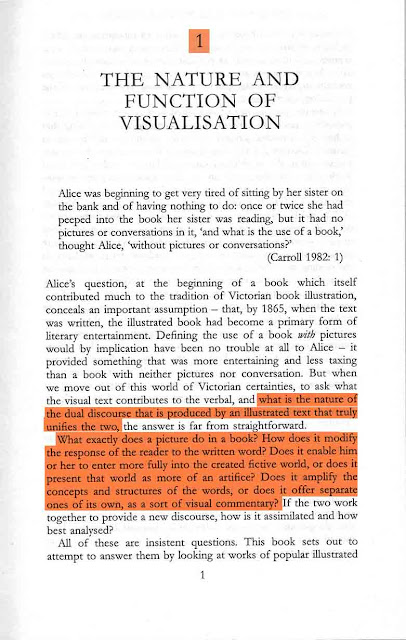


Stuart Sillars
1995

"What is the nature of the dual discourse that is produced by an illustrated text that truly unifies the two....How does it modify the response of the reader to the written word? Does it enable him or her to enter more fully into the creative fictive world, or does it present that world as more artifice? Does it amplify the concepts and structures of the words, or does it offer separate ones of its own, as a sort of visual commentary?"
This statement would be my ideal opening paragraph too! It highlights everything I wish to study on this subject. How does illustration change your perception of what you read? Does the visual interfere with the narrative 'visuals' or do they complement them? If the illustrations present a 'visual commentary' is this a bad thing?
I think what I must keep in mind is that each book, paragraph and illustration will be hugely different from the next. Therefore instead of looking at random examples I shall focus on those where the combination is successful (and of course examples where it is not) where the position, subject matter and craftsmanship are perfect, or close, and make case studies of these in the argument for the illustrated book.

"...a novel which perhaps has more claim than any other of its age to be consider as a single discourse of word and image since both are the product of the same author."
I find this hugely interesting but I feel it has exactly the same problems as any other book illustration. Since the illustrator is also the author then those drawings may be exactly how she envisioned the characters, setting ect. whilst writing it. Of course we do not know this for sure, even with the illustrations the she may have wanted the text open to visual interpretation. I think it is impossible to present a drawing and say this is it. This is fact. Given a piece of text you will always connote and denote the signs embedded therein, even without a visual, it is engrained into our human psyche through culture, knowledge and experience. (Barthes)

What if the author is not a good enough illustrator to present their vision of the text? Are we left with the wrong impression? Is this a bad thing? Therefore should there be any illustrations at all?
(Welcome to the never-ending circle of questions.)
"These circumstances make the nature and function of illustration in popular fiction of all kinds something which the serious critic may no longer ignore."
This statement may not be very important for my dissertation but I am genuinely surprised how accurate it is. The subject of the lack and decline of book illustration in adult fiction is something that appears to have been hugely over looked in the academic community. Even research in the area of the dual discourse of the visual and the written is hard to come by. It furthers my opinion that book illustration has fallen so far out of fashion and the social conciousness that it is no longer an issue to many people and furthers my want to know why.
It makes me think that while my little blog wont change these facts perhaps my illustration work can!
The game is afoot!
In this research blog for my dissertation I am aiming to address the lack of illustrations within contemporary adult fiction, the reasons for this and to decide for myself as an illustrator and avid reader of both fiction and non-fiction if this is something that should, by rights, be more prevalent in current literature.

The decline of book illustration (overlooking children's literature) appears to have been ignored and taken as a passing of the ages, of old world traditions and almost historic ways. I'd like to look both into why this is in the publishing industry, why as a culture we no longer question its lack and present a case for the renewal of the illustrated book in the contemporary best sellers lists of 'real grown up' literature.
The suggested reasons are varied and controversial. Lack of decent illustrators, a taboo on 'books with pictures in' and the rise of the digital age (Kindle, iPad & audiobooks).
The suggested reasons are varied and controversial. Lack of decent illustrators, a taboo on 'books with pictures in' and the rise of the digital age (Kindle, iPad & audiobooks).
Most importantly I intend to look at how the illustrations in a book modify your perceptions and responses to the text and specifically, the story. What are the pros and cons towards having illustrations sat amongst your text? Does it distract or enhance?
Personally I'm hoping my research weighs heavily in favour of of the illustrated book but I am not adverse to accepting the difficulties and dangers of illustrating prose or even perhaps the realisation that illustration has little to no place in the modern fiction book.
Who knows!

The game is afoot!
Subscribe to:
Posts (Atom)